Touge
House of LeavesTigers occupy a distinctive place among the animals associated with the house and its surrounding narratives. They are not presented as ordinary animals encountered in the world; instead, they appear in children’s drawings as agents of extreme violence and in hand-shadow instructions as a form that can be deliberately produced by arranging the body and light. Their recurrence links imaginative fear to visual performance, while their repeated proximity to wolves, dragons, panthers, and other creatures gives them a role in the book’s vocabulary of threat and transformation.
Appearance in the Children’s Drawings
Tigers first become significant through the drawings observed by Teppet C. Brookes. She has seen many children’s pictures of wolves, tigers, and dragons, but these drawings exceed familiar childhood fantasy. The wolves do not merely move through colored woods: they attack one another, their teeth rising from each other’s throats. The tigers do not simply sleep in a pastoral landscape; they claw through the colors of the hills, turning the image into a scene of destruction. The dragon likewise incinerates everything around it. The tiger therefore belongs to a pictorial world governed not by play or natural observation but by aggression, collision, and annihilation.
The creatures are especially disturbing because they surround an image at the center of the page. When Chad is asked to draw his house, he produces no recognizable domestic structure: there is no chimney, window, or door, only a black square occupying ninety percent of the paper. The marauding wolves, tigers, and dragon are pushed into the narrow margins around it. The tiger’s violence is thus subordinated to, and yet placed in orbit around, an even more impenetrable center. The drawing makes the house less a shelter than a sealed absence that organizes the surrounding violence.
Daisy’s drawing repeats the same arrangement. Her picture contains the same wolves, tigers, and dragon, while the central square occupies roughly two-thirds of the page and is made from several layers of black and cobalt-blue crayon. No white remains visible within it. Brookes is struck by the similarity between the five-year-old Daisy’s image and her eight-year-old brother’s. The repetition matters because the tiger is not an isolated fantasy belonging to one child; it is part of a shared visual language through which both children register the house.
Growth of the Threat
The drawings in Chad and Daisy’s room develop over time. The monstrous black square grows progressively larger and darker, until in Chad’s case even the barest margin disappears. The tigers remain among the recurring creatures around that expanding center, but the emphasis shifts from the animals alone to the increasing power of the darkness they encircle. Their claws and violence provide a visible outer register for what the black square withholds: a threat that cannot be pictured directly and therefore appears through its effects on the children’s imagery.
This progression also changes the significance of the tiger. At first it could be understood as one violent element in a child’s fantasy. As the central square expands, however, the animal becomes part of a repeated structure of displacement. The tiger is visible, colored, and legible; the darkness is not. The drawings consequently make the visible monster less frightening than the space it surrounds. The tiger gives form to alarm, but the black center suggests that the children are responding to something that exceeds any single creature.
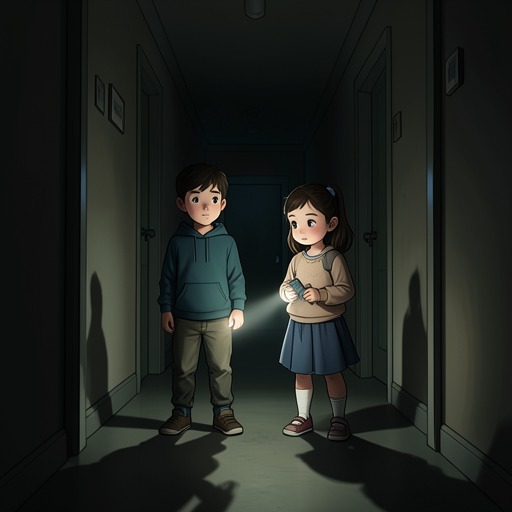
Karen’s response reinforces the connection between the drawings and the family’s crisis. She knows that Chad and Daisy are in trouble and tells them that, when their father returns, she will take them to their grandmother’s. While Navidson, Tom, and Billy Reston enter the hallway, Karen is forced to choose between monitoring the radios and caring for the children, and separation from Navidson ultimately keeps her beside the radios. The tiger imagery therefore belongs to a domestic system under pressure: the children’s pictures, the parents’ fear, and the dangerous interior of the house are presented as mutually connected rather than separate problems.
Tigers as Performed Images
Tigers also appear in the practical instructions for hand shadows. The instructions ask for examples ranging from crabs, snails, rabbits, and turtles to dragons, panthers, tigers, and kangaroos, and place these forms alongside hippos, frogs, elephants, birds of paradise, dogs, cockatoos, and dolphins. Here the tiger is no longer an uncontrollable creature in a child’s drawing. It is a shape that can be made through the coordinated arrangement of hands, light, and display conditions.
That contrast is central. In the children’s pictures, the tiger claws through the landscape and participates in a world of imagined devastation. In the hand-shadow material, the tiger belongs to a catalogue of teachable silhouettes. The same animal can therefore signify menace or technical control depending on the representational system surrounding it. The book repeatedly makes perception unstable, and the tiger demonstrates how an image may be terrifying when encountered as evidence of danger but harmless when recognized as a constructed projection.
The hand-shadow instructions also place the tiger beside the panther and dragon, creatures that elsewhere belong to the book’s darker symbolic and imaginative register. This adjacency does not erase the difference between them; it shows how easily forms migrate between play, artifice, and fear. A tiger may be drawn, projected, imagined, or made to appear in darkness, and each version depends on what the observer believes the image to be.
Narrative Significance
Tigers are therefore best understood as recurring mediators between animal life and human interpretation. They are not granted an independent plot or a stable physical presence, but their appearances reveal how the book’s human characters and children attempt to give shape to what they cannot master. In the drawings, the tiger is a visible bearer of violence around an invisible center. In the hand-shadow instructions, it becomes evidence that darkness can also be controlled, displayed, and made into entertainment.
The tiger’s recurrence contributes to the book’s broader pattern of uncertain boundaries between home and threat, reality and representation, and creature and image. It belongs to the children’s shared response to the house, yet it also belongs to a manual of deliberate visual effects. That double status prevents it from functioning as a simple symbol. The tiger is frightening because it is represented as active and destructive, but it is also revealing because its form can be reproduced. Through that tension, the animal helps show how fear is both discovered in the world and manufactured by the means used to see it.